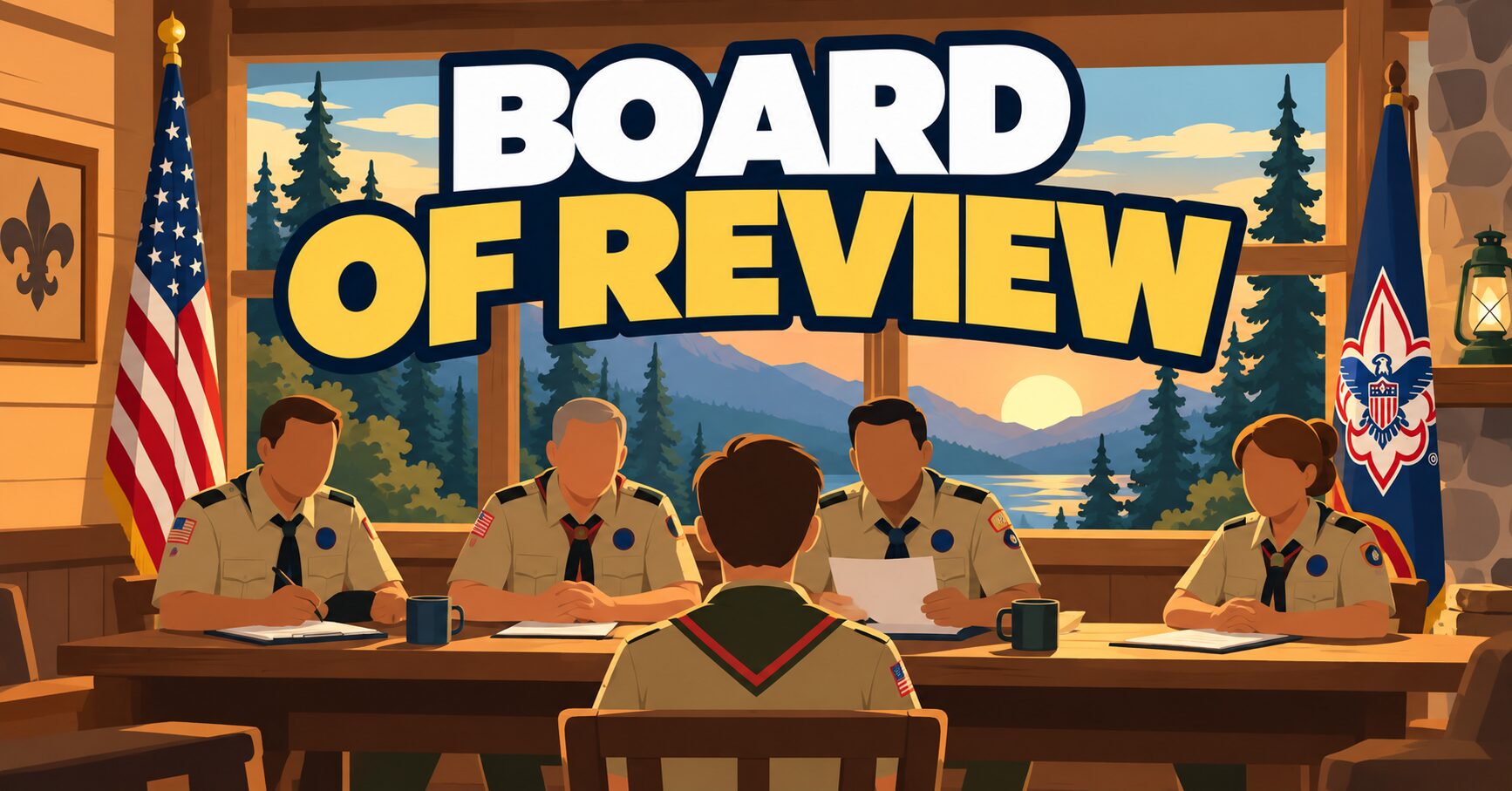
Board of Review Questions for Every Scout Rank
Sample questions for Tenderfoot, Second Class, First Class, Star, and Life boards of review, plus 9 conversation themes and tips from over 40 years of sitting on boards.
BOR Basics Tenderfoot Second Class First Class Star Life 9 Themes FAQ
What Is a Board of Review?
A Scouting America board of review is a chance for adults to talk with a Scout about what they’ve done, what they’ve learned, how it has helped them advance, and how they’re enjoying the program. After a Scout finishes the requirements for any rank except Scout rank, including a Scoutmaster conference, they meet with a board of review.
Who Sits on It
3 to 6 adults, all at least 21, usually Troop committee members. Scoutmasters, assistant Scoutmasters, and the Scout’s own parents or relatives can’t serve.
How Long
About 15 minutes, and no longer than 30, for Tenderfoot through Life. Eagle boards usually run 30 minutes or a bit longer.
Not a Retest
It must never become a retest or an “examination” of the Scout’s knowledge. In most cases, it should be a celebration of what the Scout has done.
The Decision
The Scout steps out while the board talks it over. The board must agree unanimously to approve the rank.
Source: Scouting America Guide to Advancement, Section 8, Boards of Review.
Tips for a Great Board of Review
- Stay away from yes/no questions so you get the conversation moving.
- Start easy. Personal and Troop questions help a nervous Scout relax.
- Listen more than you talk. The Scout should do most of the talking.
- Use the rank requirements as a guide, not a checklist to retest.
- End on a high note. Congratulate the Scout and talk about what’s next.
Board of Review Questions by Rank
Look at the requirements for the rank the Scout is being reviewed for and ask about the experience, not the facts. Here are sample questions for each rank. Pick a few; you won’t need them all.
Tenderfoot Board of Review Questions
- Tell us about your first campout with the Troop. What surprised you?
- Why do we whip or fuse the ends of a rope?
- What is the buddy system? When do we use it?
- Which part of the Scout Oath means the most to you? Why?
- Your fitness requirement had you track your progress for 30 days. What did you learn about yourself?
- What’s one thing you learned that you didn’t know when you joined?
- What are you looking forward to as you work toward Second Class?
Second Class Board of Review Questions
- There are 12 points to the Scout Law. Pick the one that is hardest for you to follow and tell us why.
- Tell us about a meal you cooked on a campout. What would you do differently next time?
- How did you use a map and compass on your hike or activity?
- Have you started any merit badges? Which ones, and why did you choose them? (If not, encourage the Scout to start one or two.)
- What service project did you help with? How did it feel to help?
- What would you tell a new Scout about their first summer camp?
First Class Board of Review Questions
- What did you learn about using a compass while completing the orienteering requirement?
- What does it mean to say, “A Scout is Courteous”?
- First Class is often called the “complete Scout.” What does that mean to you?
- Tell us about planning a menu for your patrol. How did you decide what to cook?
- Which Scout skill are you most confident teaching to a younger Scout?
- How has Scouting helped you somewhere outside of Scouting, like at school or home?
- What leadership position would you like to try next?
Star Scout Board of Review Questions
- What is the Outdoor Code? Why is it important?
- How have the Scout skills you’ve learned helped you in a non-Scouting activity?
- Tell us about your position of responsibility. What went well? What was hard?
- Which merit badge taught you the most? Which Eagle-required badge are you working on next?
- Tell us about your service hours. Which project meant the most to you?
- How do you help the younger Scouts in your patrol?
- What are your goals for Life rank, and when do you think you’ll be back?
Life Scout Board of Review Questions
- What has been your worst camping experience in Scouting? What did you learn from it?
- What does it mean to say, “A Scout is Reverent”?
- Tell us about a skill you taught a younger Scout. How did you use the EDGE method?
- What have you learned about being a leader? How are you different from when you made Star?
- Have you started thinking about an Eagle Scout service project? What ideas do you have?
- What does the Troop do well? What would you change if you were Senior Patrol Leader?
- Why do you want to be an Eagle Scout?
Eagle Scout boards are held differently and include a district or council representative. For ideas, see 20 questions for an Eagle board of review from Scouting magazine.
9 Board of Review Themes for Any Rank
Here are some great themes and questions for Scouts at Tenderfoot through Life. Mix and match to get the conversation going.
1. The Troop
Questions about the Troop are a great way to start a conversation. The Scout can talk about their experiences and share ideas about how the Troop works.
- When did you join our Troop?
- How many Troop meetings have you attended in the last two months?
- What is your favorite part of a Troop meeting? Your least favorite?
- Tell us about your last Troop campout.
2. Personal Information
Here is a chance for the Scout to talk about a subject they know well: themselves! These are great icebreakers.
- What grade are you in? What school?
- What hobbies do you have?
- Why did you join Scouts?
- What do you like to do when you’re not at Scouts?
3. Rank
These are some of the easiest questions, because there’s a book full of them. Look at the requirements for the rank and ask away. But beware: it must not be a retest or an “examination,” or a challenge of the Scout’s knowledge. See the questions by rank above.
4. Scouting Outside of Scouts
One way to see how a Scout is growing is to ask how Scouting relates to the “outside world.”
- What do you tell your friends about the things you learn and do in Scouts?
- What is a Good Turn? Describe a recent Good Turn you did.
- How do you help out at home, at school, or in your community?
- What class in school is most challenging for you? Why?
- What part of the Scout Oath and Law is hardest to live up to in your daily life? What part is easiest?
5. Scouting Traditions
Scouting has lots of ideas and a rich history. These questions explore the Scout’s understanding.
- Who was Lord Baden-Powell?
- Who was the Unknown Scout?
- What is the Order of the Arrow?
- Why do you think Scouts use the merit badge program?
- What is the Scout Motto? Describe how you follow it.
- What is the Scout Slogan? Describe the last time you did what it says.
6. Leadership and Teamwork
These questions show how well the program is working for the Scout, and for the Troop.
- How many Troop campouts have you attended? What did you like most? Least?
- What is the name of your patrol? Do you have a patrol flag or patch?
- How is your patrol getting along?
- Does your patrol hold patrol meetings? Are they helpful? How could the Troop help?
- Have you taught younger Scouts any of your new skills? What did you teach?
- What kind of service projects would you like to work on?
7. Progress and Goals
Setting goals and looking at progress is a great life skill. These questions help the Scout focus on the future.
- Do you want to be an Eagle Scout? Why?
- If you earn this rank today, when can we expect to see you at your next board of review? (Have the Scout write the date on the advancement page.)
- What leadership position would you like to have in the Troop?
- Have you thought about what you’d like to do as an adult? Why?
8. Values
The Scout Oath and Law are the heart of Scouting. Ask how they show up in the Scout’s life.
- Which point of the Scout Law is easiest for you to follow? Which is the most difficult?
- What does “Do your best” mean to you?
- Tell us about a time you had to make a hard choice. How did the Scout Law help?
9. The Scenario
This kind of question is unusual, but very effective. In over 40 years of boards of review, I asked the same scenario question to every Scout at every board. Hearing the answers change and mature as each Scout grew was gratifying, and it showed a lot about their progress. This is the one I used, but any scenario works as long as it has lots of possible answers.
“Imagine this: right after this meeting, a helicopter will land and take you to the middle of a national forest. It’s 50 miles to the nearest town in any direction. You’ll have whatever you have with you tonight, plus we’ll give you one more ‘thing.’ It can’t be electronic, but it should help you get home. What would that one thing be? And why did you pick it?”
What’s Next?
These questions are a great place to start, and you’ll soon develop your own. With some Scouts you’ll only need 10 questions; with others, you might need 30! Make sure the board of review is a way for the Scout to appreciate what they’ve achieved, not feel like they were grilled. Relax, and make sure everyone enjoys the process.
Celebrate the New Rank
Once the board says yes, make it official, from an Official Scouting America Licensee.
Board of Review FAQ
Who can sit on a Scout board of review?
For Tenderfoot through Life, 3 to 6 Troop committee members, all at least 21. If a Troop doesn’t have 3 committee members available, knowledgeable parents (not the Scout’s own) or other adults who understand Scouting may serve. Scoutmasters and assistant Scoutmasters can’t serve for a Scout in their own Troop, and parents or relatives can’t serve on their own child’s board.
How long does a board of review take?
About 15 minutes, and no longer than 30, for Tenderfoot through Life. Eagle boards usually run 30 minutes or somewhat longer.
Can a board of review retest a Scout on skills?
No. The Guide to Advancement says a board of review must never become a retest or “examination.” Ask about the experience, like “Tell us about using a compass on your hike,” not “Show us how to take a bearing.”
Is there a board of review for Scout rank?
No. Boards of review start at Tenderfoot. Scout rank is signed off without one.
Can the Scoutmaster be in the room?
Yes, but only to observe. The Scoutmaster can introduce the Scout but doesn’t take part unless the board asks.
Can a Troop hold practice boards of review?
No, practice boards aren’t allowed. Leaders can talk with Scouts about the kinds of questions to expect, and this page is a good place to start.
Does the Scout have to wear the full uniform?
The full field uniform is preferred, but a board of review can’t be denied or delayed because of the uniform. Neat and clean works too.
Are there coupons for Troop gear?
Sign up for Scouting coupons and we’ll email you offers for your Troop’s next order.
Get Scouting Coupons & Offers
Coupons for your Troop, new Scouting designs, and more program ideas like this one.
More Scouting Program Ideas
Best board of review members Scoutmaster conferences Court of Honor ideas What is a patrol? All free Scouting resources
References
Guide to Advancement (Scouting America)
The Scouts BSA Board of Review: FAQs (Scouting magazine)
20 Questions to Ask at Your Next Eagle Board of Review (Scouting magazine)
Sample Board of Review Questions
ClassB is an Official Licensee of Scouting America
Scouting America®, and the Universal Emblem, Arrow of Light®, Badges of Rank, Cub Scout™, Scouting®, Venturing® and all related marks are trademarks of Boy Scouts of America d/b/a Scouting America in the United States and/or other countries. Manufactured under license from the Boy Scouts of America d/b/a Scouting America. All rights reserved.